When people think about the second-hand smartphone market, they often imagine a simple process:
A consumer sells an old iPhone to a recycling platform. The platform inspects it, then resells it to another consumer.
That’s certainly one part of the story.
But if we zoom out, we’ll discover something much bigger. Behind every used iPhone is a global supply chain connecting consumers, recycling companies, wholesalers, refurbishment centers, and distributors across different countries.
As the CEO of Norephone, I’ve been working in cross-border sourcing and procurement for second-hand smartphones and mobile phone components for over 10 years. Part of my work has involved sourcing used smartphones, LCD screens, and other mobile phone components from overseas suppliers, purchasing inventory in international markets, and arranging shipments to Hong Kong.
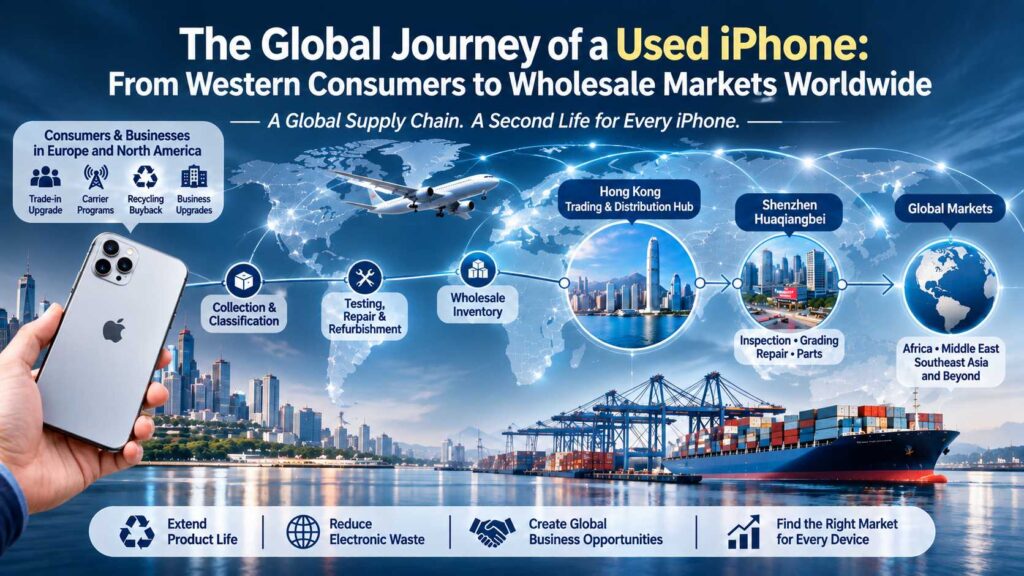
So today, I don’t want to look at this industry from a consumer’s perspective. Instead, let’s follow the journey of a used iPhone from Europe or North America and explore how it might travel across borders before eventually reaching another user somewhere in the world. This is not a fixed route for every device. Different countries, suppliers, product conditions, and business models have their own distribution channels. What I’m sharing here is one of the supply chain routes I’ve become familiar with through my years in the industry.
It All Starts with Consumers and Businesses in Western Markets
A used iPhone can enter the second-hand market through several channels.
For example:
- Consumers trading in their old iPhones when upgrading to newer models.
- Mobile network operators collecting devices through trade-in programs.
- Smartphone recycling and buyback platforms.
- Businesses replacing company phones and disposing of older device inventories.
Once collected, these devices don’t automatically become electronic waste. Many still have plenty of usable life left. Depending on their condition, they may follow different paths:
- Fully functional devices: Enter the second-hand smartphone market for resale.
- Devices with minor issues: Go through testing, repair, or refurbishment.
- Damaged devices: May be dismantled for reusable components such as LCD screens, cameras, motherboards, and other parts.
- Devices with little remaining value: May eventually enter appropriate electronic recycling channels.
In other words, one collection point can become the starting point for several different supply chains.
From Individual Phones to Wholesale Inventory
This is where things become particularly interesting from a B2B perspective. At the consumer level, a used iPhone is usually treated as an individual product. But in the wholesale market, things work differently. Devices are consolidated into inventory batches, often containing dozens, hundreds, or even thousands of units.
A wholesale inventory list might include:
- iPhone 11, 12, 13, 14, and newer models.
- Different storage capacities.
- Different cosmetic conditions and grades.
- Different network and carrier lock statuses.
- Different functional conditions and testing results.
For wholesalers, importers, and distributors, these details matter.
A buyer isn’t simply purchasing a collection of used phones. They are purchasing inventory that needs to match their target market, customer demand, pricing expectations, and resale strategy.
As a professional used iPhone wholesaler, Norephone understands the importance of reliable sourcing, accurate grading, transparent product descriptions, and consistent inventory management in the second-hand smartphone wholesale business.
That’s why we focus on providing carefully selected inventory, clear grading standards, detailed product information, and stable supply solutions to meet the diverse needs of international wholesalers, importers, and distributors. Whether you are looking for specific iPhone models, different storage capacities, or bulk quantities across multiple grades, Norephone aims to make the sourcing process more straightforward and reliable.
Why Does So Much International Trade Pass Through Hong Kong?
One question I often hear is:
Why do so many second-hand smartphones from overseas markets end up going through Hong Kong?
The answer is that Hong Kong is not necessarily the final destination for these devices.
For many businesses in the international used phone trade, Hong Kong serves as an important trading, consolidation, transshipment, and distribution hub. Its role is closely connected to the wider electronics supply chain in Southern China. Once used smartphones arrive in Hong Kong, their journeys can branch out in different directions. Some inventory is purchased by international traders and distributors based in Hong Kong, then shipped to markets across Africa, the Middle East, Southeast Asia, and other regions. Other batches may move into the second-hand electronics ecosystem around Huaqiangbei in Shenzhen. There, depending on the product and its condition, devices may undergo further inspection, grading, sorting, repair, refurbishment, or component harvesting. They can then enter different domestic and international sales channels.
It’s important to understand that not every device follows this exact route. Different suppliers and buyers have their own sourcing and distribution arrangements. But Hong Kong and Shenzhen remain important parts of the broader international electronics trading ecosystem.
Shenzhen and Huaqiangbei: Where the Supply Chain Continues
For anyone involved in the mobile phone wholesale business, Huaqiangbei is a name worth knowing. Located in Shenzhen, Huaqiangbei is widely recognized as one of the world’s major electronics trading and supply chain centers. Its ecosystem covers much more than brand-new electronic products. It also includes second-hand smartphones, replacement screens, mobile phone components, repair services, refurbishment businesses, and parts distributors. This creates opportunities for used devices to be evaluated and processed according to their condition and potential market value.
A fully functional iPhone may be prepared for resale.
A device with a damaged screen may be sent for repair.
A phone that is no longer economical to refurbish may still contain valuable reusable components.
This is one of the reasons why the second-hand smartphone and mobile phone parts industries are so closely connected. They are not separate markets. They are different parts of the same value chain.
One Used iPhone, Different Markets, Different Values
After more than 10 years in cross-border sourcing, one thing has become increasingly clear to me. The most interesting part of this industry isn’t simply selling old smartphones. It’s connecting supply with demand across different markets.
Think about it. A consumer in Europe or North America may consider an older iPhone ready for replacement. But in another country, that same model may still be an attractive option for someone looking for a reliable smartphone at a more affordable price.
The same device can have different market values depending on:
- Local purchasing power.
- Consumer preferences.
- Smartphone replacement cycles.
- Availability of new and used devices.
- Local repair capabilities.
- Import costs and distribution channels.
What one market no longer needs may be exactly what another market is looking for. That’s the real value of international second-hand electronics trading. It’s not just about moving used products from one country to another. It’s about finding the right market for each device and extending the useful life of electronic products.
Final Thoughts: The Global Second-Hand Phone Market Is Here to Stay
After working in this industry for more than a decade, I believe the second-hand smartphone business is much bigger than many people imagine. Behind every wholesale order is a network of suppliers, buyers, inspection teams, logistics providers, repair specialists, and distributors. Every device has its own journey. Some travel across continents as complete smartphones. Others are repaired, refurbished, or dismantled into reusable components. But they all share one thing: they still have value somewhere in the global market. As long as people continue upgrading their smartphones, businesses keep replacing their devices, and consumers around the world look for more affordable electronics, there will be opportunities in the second-hand smartphone industry. And as long as the world keeps turning, this global supply chain will keep moving.
At Norephone, our mission is to source quality used electronics, provide reliable wholesale supply, and connect buyers with the right inventory for their markets. We are committed to helping used devices find their next destination while creating long-term value for our global business partners.
For wholesale inquiries, please feel free to contact us.